Abstract
As the geriatric population continues to grow, the use of mobility and disability aids– including canes, walkers, wheelchairs, and patient lifts–has become increasingly common. While these devices are essential for maintaining independence and preventing falls, they are not without risks. This review examines injuries associated with mobility aids, particularly lifts, in adults aged 65 years and older, emphasizing patterns of injury, high-risk populations, and implications for family medicine practice. While most discussions center on ambulation-related falls, emerging data highlight that transfer-related incidents involving mechanical or manual lifts pose a greater injury risk, particularly to the head and neck and disproportionately affecting women and individuals over 85 years of age.5 Biomechanical vulnerability, age-related musculoskeletal decline, and improper device use all contribute to this elevated risk. Osteopathic manipulative medicine offers a nonpharmacologic option to enhance balance and proprioception, thereby reducing fall risk and complementing preventive care strategies.11 Family physicians are uniquely positioned to mitigate these risks by providing patient and caregiver education, coordinating in-home services, and addressing systemic barriers to mobility aid use. Understanding the injury risks associated with these devices and implementing targeted preventive strategies can significantly enhance safety and patient outcomes.
Corresponding Author(s)
Allison Brown, [email protected]
The authors certify that they have no affiliations with or involvement in any organization or entity with any financial interest, or nonfinancial interest, in the subject matter or materials discussed in this manuscript.
Read the article
INTRODUCTION
Mobility and disability aids, including canes, walkers, rollators, and wheelchairs and lifts play a vital role in maintaining independence and preventing falls among the geriatric population and adults with disabilities. In the United States, nearly 24% of community-dwelling adults aged 65 years and older rely on at least one mobility device, and this number is expected to rise with an aging population.1 While these devices are designed to enhance safety and functional mobility, they are not entirely without risks. Injuries and falls related to mobility aids pose a significant concern in primary care, often resulting from improper use, poor fit, or environmental factors leading to emergency department visits, hospitalizations, loss of function, and increased caregiver strain.
Mechanical and manual patient lifts warrant particular attention. Despite their intended purpose of facilitating safe transfers, these devices account for a disproportionate number of traumatic events. These risks are especially pronounced in older adults with frailty, osteoporosis, or neurologic impairment. Understanding the specific risks, injury patterns, and vulnerable populations affected by these devices is critical for family physicians seeking to deliver safe and comprehensive care.2
Although mobility aids are widely used, substantial gaps persist in provider training, caregiver instruction, and standardized safety practices. The objective of this review is to examine the traumatic injuries associated with mobility and disability aids in adults aged 65 years and older, and to highlight evidence-based strategies within family medicine to enhance safety and patient outcomes.
METHODS
This review was conducted using publicly available data from the United States Consumer Product Safety Commission’s National Electronic Injury Surveillance System (NEISS).3 The query was built using the most recent 5 years, 2020 through 2024. Injury-associated products were divided by selecting codes 1706, 1707, and 1889, which represent crutches/canes/walkers, wheelchairs, and elevators or other lifts (excluding escalators/hoists/ jacks/forklifts/automotive lifts), respectively. Age was grouped in years of 5 from aged 65 years to 85 years and older. All body parts were included in the search but were categorized into head and neck, upper extremity, torso, lower extremity, internal, all body, and unknown location of injury. All diagnoses and dispositions were included.
No injury cases were identified under codes 1706 or 1707 within the selected timeframe and inclusion parameters. This absence reflects NEISS data collection and sampling data, in which only emergency department−treated injuries directly related to a consumer product are captured. Patients who seek care at the primary care clinic or through nursing home and assisted living care are excluded from the data. Furthermore, the NEISS database will exclude cases if the sample number for the product code is too small to generate a stable national estimate. Consequently, only data pertaining to product code 1889, elevators and patient lifts, were manually extracted and organized thematically across categories including age distribution, gender, and injury locations.
Peer-reviewed literature was identified using the National Institutes of Health (NIH) databases, including PubMed and PubMed Central. Search terms included combinations of “geriatrics,” “mobility aids,” “falls,” “patient lifts,” “injury prevention,” and “osteopathic manipulative medicine (OMM).” Emphasis was placed on articles that included information relative to the injury pattern, patient demographics, or outcomes related to the use of canes, walkers, wheelchairs, or lifts in adults aged 65 years or older. Studies were excluded if they focused on pediatric or nongeriatric populations. Eligible studies were reviewed to evaluate device-specific injury trends, age and gender-related disparities, and adjunctive interventions such as OMM and education.
Figure 1 shows data retrieved from the NEISS database between 2020 and 2024 for all injuries that were reported in people over 65 years in both males and females. The data are grouped into 5-year ranges. Initially the number of cases from the 65- to 69-year category to the 75- to 79- year category decreased. The number of cases starts to rise in the 80- to 84-year category with 126 cases. The highest number of reported cases, 207, are in the 85+ years and older category, which may reflect the larger proportion of individuals in this category due to its broader age range.
FIGURE 1: Number of total injuries in the population over the age of 65 years, categorized in 5-year intervals. Data are collected from the NEISS database between 2020 and 2024.
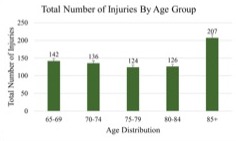
Figure 2 shows the total number of injuries in people over 65 years of age separated by male and female gender between 2020 and 2024. In the line graph, the orange bar with the associated R2 value represents the female injuries and the blue bar with the associated R2 value represents the male injuries. There was an overall increase in the number of cases in both male and female genders. In female cases from 2020 to 2021, the number of cases increased by 29, remained relatively stable from 2021 to 2023, and then rose by an additional 28 cases in 2024. The R2 = 0.9031 for female cases indicates a statistically significant increase in female cases. In male cases from 2020 to 2021, the number of cases decreased by nine, remained relatively stable from 2021 to 2022, rose by 29 cases in 2023, then decreased by ten in 2024 as represented in Figure 2. The R2 = 0.4085 shows statistical significance but is not as strong as the female cases.
FIGURE 2: Number of total injuries in people over 65 years of age separated by male and female genders between 2020 and 2024. All data were collected from the NEISS database.
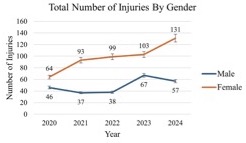
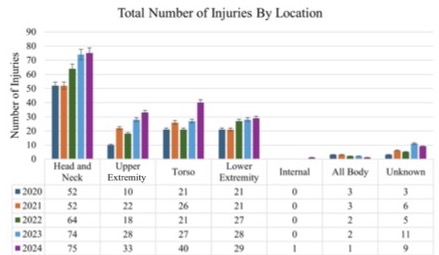
Figure 3 shows the types of injuries reported to the NEISS database for people over 65 years between 2020 and 2024. Head and neck injuries consistently accounted for the highest number of cases, with cases rising by 23 between 2020 and 2024. Injuries to the upper extremity and torso showed a notable rise over the study period, upper extremity cases rose by 23, and torso cases rose by 19 during the 2020 to 2024 study period. There was a lower increase in the number of lower extremity cases, increasing by eight over the study period. Internal injuries were rarely seen, with only one reported case in 2024. All body and unknown injuries remained low across the study period with an unusual peak in unknown injuries in 2023.
FIGURE 3: Data collected from the NEISS database of types of injuries in the population age 65 years and older between 2020 and 2024. Types of injuries include head and neck, upper extremity, torso, lower extremity, internal, all body, and unknown.
DISCUSSION
Data extracted from the NEISS database, together with the supporting literature, provide an overview of injury patterns associated with mobility aids in the geriatric population. Although no reportable cases were identified for canes, walkers, or wheelchairs within the dataset, the injuries linked to patient lifts offer valuable insight into a high-risk area of mobility assistance. The analysis revealed consistent trends in gender and injury location. These findings form the basis for a broader discussion on the mechanisms, contributing factors, and preventive opportunities related to mobility-aid injuries in older adults.
Mobility Aids and Patient Population
Mobility aids are widely used by older adults to compensate for impaired gait, balance dysfunction, and musculoskeletal decline, with nearly 24% of community-dwelling individuals 65 years of age and older relying on at least one such device.1 Canes are typically employed for minor balance support or unilateral weakness, while walkers provide a broader base of support and are commonly used by individuals with bilateral lower-extremity instability or deconditioning. Wheelchairs, by contrast, are reserved for those with more profound mobility limitations, neuromuscular disorders, or cardiopulmonary compromise, and are associated with reduced ambulatory fall risk but higher baseline frailty.4 While these devices are intended to enhance safety, their use introduces new injury risks–most notably falls related to improper technique, poor device fit, or environmental obstacles. However, data increasingly show that the highest proportion of mobility-related injuries among older adults occurs not during ambulation with these aids, but rather during transfers involving manual or mechanical lifts.5 These findings suggest that while traditional mobility aids carry recognized fall and fracture risks, transfer mechanics and lift-related activities may represent a more acute source of injury burden in the geriatric population and warrant targeted preventive strategies.
The Effects of Age and Gender
Figure 1 displays how the total number of injuries from mobility lifts among adults ≥65 year from the year 2020 to 2024 remains relatively constant and has no significant variance, with the exception of individuals aged 85 years and older. The increase seen within the 85 years of age and older group may be attributable to deterioration in overall health status with age including balance difficulty, bone fragility, etc.6 Similarly, as seen in Figure 2, elderly women experience a significantly higher incidence of injuries related to mobility lift use compared to men. One study analyzing 3932 mobility aid-associated falls found that women represented 70.5% of cases, with rates twice as high in fracture and hospitalization than men.7 The disparity is attributed in part to higher baseline prevalence of osteoporosis and reduced bone mineral density among elderly women and aging populations, increasing fracture risk even with low-energy mechanisms. Gender-related differences in reporting and healthcare-seeking behaviors may further influence injury detection, as older women are more likely to seek care after a fall, while men may underreport or delay evaluation.8 Together, these findings underscore the need for gender-informed fall-prevention strategies, including targeted training for mobility aid use, mobility lift use, and earlier screening for musculoskeletal frailty in elderly women.
Location of Injury
Falls involving patient lifts, particularly mechanical or manual sit-to-stand and floor lifts, are associated with a disproportionately high rate of head and neck injuries in older adults due to biomechanical and situational factors unique to the transfer process, as seen in Figure 3. Unlike ambulatory falls where forward momentum often leads to distal extremity impact, lift-related incidents typically involve vertical collapse or uncontrolled backward descent, placing the occiput, cervical spine, and posterior cranium at direct risk of blunt trauma. Data from observational safety analyses show that falls from lifts frequently result in occipital lacerations, concussions, and cervical strain due to lack of protective reflexes and the inability of frail patients to brace during descent.9 These forces are exacerbated in patients with preexisting degenerative joint disease, vertebral osteoporosis, or limited neck mobility, further increasing the likelihood of injury to the head and cervical region. The high center of gravity during upright transfer also makes lateral balance more difficult, contributing to sideward falls that put the arms, torso, and lower extremity at risk for injury. This injury pattern emphasizes the need for stricter adherence to lift protocols, caregiver training, and proper fit and function of mechanical transfer devices in the geriatric setting.
PREVENTING AND TREATING WITH OSTEOPATHIC MANIPULATIVE THERAPY
OMM offers a nonpharmacologic approach to improving balance. Because OMM can improve patient balance, it aids in reducing the risk of falls in patients with and without the dependence of mobility aids and can increase postural balance in elderly patients requiring mobility lifts. The University of North Texas Health Science Center conducted a research study that demonstrated a comprehensive protocol of seven OMM techniques applied weekly over 4 weeks improved postural stability of patients over the age of 65 years.10 Their protocol consisted of soft-tissue and myofascial release to the thoracic, lumbar, and sacral regions. Myofascial release was also directed towards the shoulders and scapulae bilaterally. The cervical spine was treated with myofascial release, counterstrain, muscle energy, or soft-tissue techniques for release and correction, depending on the severity. Cranial mechanics were assessed and treated with occipital and condylar decompression, venous sinus technique, V-spread and frontal-parietal lifts, CV4 technique, and counterstrain of tender points. In total, OMM techniques were applied for 25 to 30 minutes.
Together, these techniques improve joint mobility, enhance proprioceptive feedback, reduce somatic dysfunction, and optimize neuromuscular coordination, all of which contribute to better postural control and improve balance in older adults. The physiologic mechanisms underlying these improvements are multifactorial. By reducing somatic dysfunctions and fascial restrictions, OMM enhances proprioceptive input from the joint capsules and muscles, improving neuromuscular coordination and postural reflexes.11 Additionally, gentle cranial and cervical techniques may optimize vestibular function and cerebrovascular flow, further stabilizing balance control.12 When incorporated into comprehensive geriatric care, OMM can complement physical therapy and exercise-based interventions to provide a gentle modality to treat frail and mobility-limited patients. While OMM can be beneficial for this population, there are certain relative contraindications that must be considered. Specifically, high-velocity low-amplitude (HVLA) techniques are generally avoided in this population due to osteoporosis, osteoarthritis, and vascular compromise.13
TACKLING EDUCATION, RESOURCES, AND BARRIERS
In the management of injuries associated with mobility aids in the geriatric population, family medicine serves as a cornerstone for establishing comprehensive patient-centered care. Through proactive education, physicians equip both patients and caregivers with tools to safely integrate assistive devices, adapt home environments, and build confidence in mobility, thereby reducing fall risk.14 Home health services, coordinated through the family practitioner, deliver tailored interventions such as skilled nursing, physical therapy, and occupational therapy to assess and modify the home setting for safer mobility.15 Additionally, government-funded programs, such as Medicare’s Home Health Benefit and local Area Agencies on Aging provide financial and logistical support for in-home care and assistive device acquisition.16 Despite the widespread use and need for these resources, stigmatization of mobility aid use in older adults often leads to delayed or inappropriate adoption of necessary devices, which can increase the risk of fall and injury.17 Other barriers to mobility aid use include lack of access to local medical offices, limited transportation to appointments, and increased costs.18 Medicare Part B will cover 80% of the cost of mobility aids, but only after the deductible has been met.19 Family medicine practitioners are uniquely positioned to address the barriers affecting mobility aid use by fostering open dialogue, normalizing the use of mobility aids, and encouraging proactive management with available resources.
LIMITATIONS
A key limitation across the study is the reliance on emergency department data, which may disproportionately capture higher-acuity cases and exclude individuals who seek care through the primary care physician or manage injuries at home, thereby underestimating the true incidence of mobility device-related falls. Differential access to care based on gender, socioeconomic status, and living environment may influence utilization of the emergency department as well.8 Self-reported data in mobility aid use and fall history introduce potential misclassification bias whether from poor recall, injury circumstances, or injury outcome.1 Additionally, lack of longitudinal follow-up limits the access to data to observe recovery, functional decline, or recurrent injury. Because the NEISS query did not yield sufficient reportable cases for mobility aids, such as canes, walkers, or wheelchairs, the detailed analysis of age, gender, and injury location reflects only lift-related incidents; therefore, findings cannot be generalized to other categories of mobility aids.
CONCLUSION
Mobility aids are essential for maintaining independence and reducing fall risk in older adults, but their use, specifically during transfers involving mechanical or manual lifts, can introduce significant injury risks, particularly head and neck trauma. Transfer-related falls involving mechanical or manual lifts represent a substantial portion of reported injuries related to mobility aids in the geriatric population, with the highest numbers observed among patients aged 85 years and older and a disproportionate representation of women. These patterns highlight the need for improved caregiver training, stricter lift protocols, and patient-specific risk assessments that consider age, gender, and functional mobility. OMM offers a promising, nonpharmacologic approach to improving balance and reducing falls through techniques that enhance proprioception, postural control, and neuromuscular function. Family medicine practitioners play a critical role in addressing barriers to safe mobility aid use by educating patients and caregivers, coordinating supportive services, and advocating for early intervention. Future research should move beyond emergency department data to capture broader and longer-term outcomes, ultimately guiding more effective patient-centered strategies for mobility safety in older adults.
REFERENCES
- Gell NM, Wallace RB, LaCroix AZ, Mroz TM, Patel KV. Mobility device use in older adults and incidence of falls and worry about falling: findings from the 2011–2012 National Health and Aging Trends Study. J Am Geriatr Soc. 2015;63(5):853-859. doi: https://doi.org/10.1111/jgs.13393
- AbdulRaheem Y. Unveiling the significance and challenges of integrating prevention levels in healthcare practice. J Prim Care Community Health. 2023;14:215013192311865009. doi: 10.1177/21501319231186500
- CPSC NEISS On-Line Query System. U.S. Consumer Product Safety Commission. Accessed June 5, 2025. https://www.cpsc.gov/cgibin/ NEISSQuery/home.aspx
- Axelsson KF, Litsne H, Lorentzon M. Comparison of fractures among older adults who are ambulatory vs those who use wheelchairs in Sweden. JAMA Network Open. 2023;6(2):e2255645. doi: https://doi. org/10.1001/jamanetworkopen.2022.55645
- Tsai S, Pirruccio K, Ahn J. The brief window of time comprising a wheelchair transfer confers a significant fracture risk on elderly Americans. Public Health. 2020;182:1-6. doi: https://doi.org/10.1016/j. puhe.2020.01.002
- Grundstrom AC, Guse CE, Layde PM. Risk factors for falls and fall-related injuries in adults 85 years of age and older. Arch Gerontol Geriatr. 2012;54(3):421-428. doi: https://doi.org/10.1016/j.archger.2011.06.008
- Stevens JA, Sogolow ED. Gender differences for non-fatal unintentional fall related injuries among older adults. Injury Prevention. 2005;11(2):115- 119. doi: https://doi.org/10.1136/ip.2004.005835
- Stevens JA, Ballesteros MF, Mack KA, Rudd RA, DeCaro E, Adler G. Gender differences in seeking care for falls in the aged Medicare population. Am J Preventive Med. 2012;43(1):59-62. doi: https://doi. org/10.1016/j.amepre.2012.03.008
- Manckoundia P, Mourey F, Perennou D, Pfitzenmeyer P. Backward disequilibrium in elderly subjects. Clin Interv Aging. 2008;3:667-672. doi: https://doi.org/10.2147/cia.s3811
- Lopez D, King HH, Knebl JA, Kosmopoulos V, Collins D, Patterson RM. Effects of comprehensive osteopathic manipulative treatment on balance in elderly patients: a pilot study. Journal of Osteopathic Medicine. 2011;111(6):382-388. doi: https://doi.org/10.7556/jaoa.2011.111.6.382
- Tramontano M, Consorti G, Morone G, Lunghi C. Vertigo and balance disorders – the role of osteopathic manipulative treatment: a systematic review. Complementary Med Res. 2020;28(4):368-377. doi: https://doi. org/10.1159/000512673
- Atay F, Bayramlar K, Sarac E. Effects of craniosacral osteopathy in patients with peripheral vestibular pathology. ORL J Otorhinolaryngol Relat Spec. 2020;83(1):7-13. doi: https://doi.org/10.1159/000509486
- Noll DR, Channell MK, Basehore PM, et al. Journal of Osteopathic Medicine. 2013;113(4):276-289. doi: https://doi.org/10.7556/ jaoa.2013.113.4.276
- Centers for Disease Control and Prevention. About older adult fall prevention. Accessed June 6, 2025. https://www.cdc.gov/falls/about/ index.html
- FastStats. Cdc.gov. Accessed June 6, 2025. https://www.cdc.gov/nchs/ fastats/home-health-care.htm
- ACL Administration for Community Living. Program and policy areas. Accessed June 6, 2025. https://acl.gov/programs
- Phelan EA, Mahoney JE, Voit JC, Stevens JA. Assessment and management of fall risk in primary care settings. Med Clin North Am. 2015;99(2):281-293. doi: https://doi.org/10.1016/j.mcna.2014.11.004
- Urban Institute. Barriers to accessing medical equipment and other health services and supports within households of adults with disabilities. Accessed June 16, 2025.. https://search.issuelab.org/ resources/43446/43446.pdf
- Centers for Medicare & Medicaid Services. 2025 Medicare parts A & B premiums and deductibles. Accessed June 16, 2025. https://www. cms.gov/newsroom/fact-sheets/2025-medicare-parts-b-premiums-and-deductibles#:~:text=Medicare%20Part%20B%20Premium%20 and%20Deductible&text=The%20annual%20deductible%20for%20 all,deductible%20of%20%24240%20in%202024