Abstract
Hospice patients often experience persistent dyspnea, anxiety, and pain despite pharmacologic treatment. OMT is a gentle nonpharmacologic adjunct that may support comfort and reduce symptom burden near the end of life. However, hospice-specific clinical evidence describing OMT use remains extremely limited. This narrative review summarizes the available hospice and end-of-life literature related to OMT, highlights appropriate techniques, and discusses practical considerations for integrating OMT into interdisciplinary hospice care. Expanding hospice-focused osteopathic education and research may help define OMT’s role in improving comfort, dignity, and whole-person care at the end of life.
Corresponding Author(s)
Tiffani Najadifar, MS, OMS-IV, [email protected]
The authors have no relevant financial relationships or conflicts of interest to disclose.
Read the article
INTRODUCTION
OMT is an established component of osteopathic practice used to reduce pain, relieve somatic dysfunction, and support physiologic function through gentle hands-on techniques. In the context of hospice care, these principles align with the central goal of promoting comfort, dignity, and quality of life for patients at the end of life.
Despite this conceptual fit, OMT remains infrequently described in hospice-specific literature, with limited published data describing its feasibility, utilization, or perceived value among hospice teams. Existing literature suggests that OMT may reduce symptom burden, improve ease of positioning, and support relaxation in terminally ill patients. However, these applications have not been widely integrated into hospice care models described in the literature.
Hospice utilization has risen steadily. Over 1.7 million Medicare patients received hospice care in 2021, with nearly half of all Medicare decedents using hospice services before death.1 Despite this growth, many patients near the end of life continue to experience distressing symptoms, particularly dyspnea, anxiety, and pain, which are not fully managed by conventional pharmacologic therapies.
OMT has shown promise in alleviating such symptoms in select clinical contexts by improving respiratory mechanics, modulating autonomic tone, and reducing muscular tension.2 However, published literature suggests that integration of OMT into hospice care may be constrained by logistical barriers and limited awareness among hospice providers. As of 2010, there were approximately 70,480 practicing doctors of osteopathic medicine (DOs) in the United States.3 At that time, only about 300 DOs were practicing within hospice and palliative medicine, indicating a relative underrepresentation of osteopathic physicians in this area.3
Given their training in holistic patient-centered care, osteopathic family physicians are uniquely suited to help close this gap. The objective of this narrative review is to examine the current evidence and practical considerations for OMT, specifically in hospice care. We aim to summarize existing studies evaluating OMT in hospice settings, describe techniques most applicable to fragile or bed-bound patients, and discuss strategies to integrate OMT into interdisciplinary hospice practice.
METHODS
We conducted a narrative review of the literature to identify studies relevant to the use of OMT in hospice care. A PubMed search was performed using combinations of the following keywords: “osteopathic manipulative treatment,” “OMT,” “hospice care,” “dyspnea,” “anxiety,” “terminal illness,” and “symptom management.” Additional references were identified through manual review of bibliographies and relevant osteopathic journals, including Journal of Osteopathic Medicine (formerly JAOA) and Osteopathic Family Physician, as well as through Google Scholar.
Studies were included if they involved patients of any age (adult or pediatric) receiving OMT in inpatient, residential, or home-based hospice settings. Searches were limited to English-language publications from 2000 to 2024. Studies were excluded if they: focused exclusively on palliative or supportive care without explicit inclusion of hospice-enrolled patients or hospice-level care, did not involve OMT or osteopathic principles, were commentaries, editorials, or opinion pieces without original data, were not published in English, were published prior to 2000, or did not have full-text access available.
For the purposes of this review, hospice care is defined according to the Centers for Medicare & Medicaid Services (CMS) criteria as interdisciplinary comfort-focused care for patients with a prognosis of 6 months or less who have elected to forgo curative treatment in favor of symptom management and quality of life.4 Palliative care, by contrast, refers to specialized medical care for patients with serious illness that may be provided concurrently with curative or life-prolonging therapies.
Although hospice care is considered a subset of palliative care, this review intentionally excluded studies conducted exclusively in palliative or supportive care settings, unless the patient population met hospice eligibility criteria or was explicitly described as receiving hospice-level care. However, because hospice-specific OMT research is limited, closely related palliative literature was briefly summarized for context in the “Results” section to highlight broader trends and conceptual relevance. This approach maintains a primary focus on hospice-level care while situating the findings within the larger field of end-of-life medicine.
To structure the analysis, studies were grouped into three categories based on their relationship to hospice care and OMT.
RESULTS
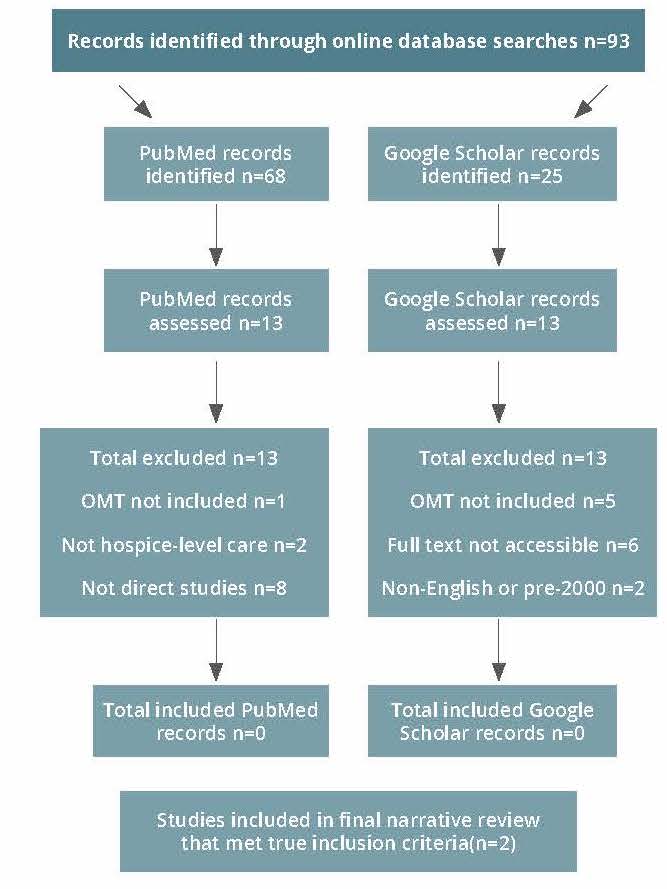
After applying the inclusion and exclusion criteria, no clinical studies were identified that directly evaluated OMT use in hospice-enrolled patients. As a result, Category A (hospice-specific OMT studies) contains no empirical studies. Because no studies met full inclusion criteria, the primary evidence base for OMT in hospice care is effectively absent. To contextualize this gap, we categorized additional literature describing theoretical OMT use in hospice and palliative care as Category B studies. Although these publications did not meet hospice eligibility criteria
Collectively, these sources demonstrate that OMT has been described as a feasible and well-tolerated adjunct for symptom management near the end of life, though empirical hospice-specific data remain sparse. The findings from each category are summarized below.
Figure 1: Search and Inclusion Process
Category A: Hospice-Specific Studies
No studies met full inclusion criteria for Category A. Despite an extensive search, no clinical trials, observational studies, or case series were identified that examined the use of OMT specifically in hospice-enrolled patients or evaluated osteopathic interventions delivered within hospice programs. This absence highlights a critical evidence gap and underscores the need for formal research directly addressing OMT in hospice settings.
Category B: OMT in Palliative or Advanced- Illness Populations
Eight publications evaluated OMT in palliative-care or advanced-illness populations that did not meet hospice eligibility criteria, or were not conducted in hospice-enrolled patients, but provide valuable contextual insight. Varas et al presented an educational workshop abstract describing the role of OMT within hospice and palliative medicine through a mind-body-spirit framework.3 The abstract highlights several key themes relevant to hospice practice, including the use of OMT as a low-risk nonpharmacologic adjunct for pain relief. The authors emphasize that, despite limited numbers of DOs practicing in hospice and palliative medicine, simple OMT techniques can be feasibly incorporated at the bedside. They described the use of gentle bedside OMT techniques, including soft-tissue stretching and decompression alongside myofascial release to alleviate pain and promote relaxation in hospice and palliative medicine patients.3 The workshop describes the practicality of short low-intensity treatments for frail or bed-bound individuals, illustrating practical feasibility and growing interdisciplinary interest in OMT for comfort-focused care.3 Choy provided a comprehensive narrative overview describing the potential role of OMT in hospice and palliative care, emphasizing its alignment with the concept of total pain.5 Although the article did not present original clinical data, it outlined how OMT may complement pharmacologic symptom management for pain, dyspnea, bowel dysfunction, anxiety, and lymphedema. Based on studies from postoperative care, chronic low back pain, and pediatric oncology, Choy suggested that these findings may hold relevance for seriously ill hospice patients despite the absence of hospice-specific research. The author also discussed barriers to implementation, including limited awareness, a small evidence base, and uncertainty among clinicians. He argues that OMT represents a practical holistic modality that aligns well with family medicine principles and the goals of end-of-life care. Estrada et al outlined the relationship between osteopathic medicine and palliative care, shedding light on pertinent OMT skills through an interactive and hands-on workshop open to all healthcare workers.6 Arienti et al conducted a small nonrandomized clinical trial in hospitalized geriatric oncology patients. In their study, they found that OMT significantly reduced pain over a 4-week period compared with baseline, although improvements in quality of life were not statistically significant.7 While not performed in hospice settings, the study demonstrates that OMT can safely reduce pain in medically frail older adults with advanced cancer, which is an effect that may be relevant to symptom-management needs in hospice populations. Ngo et al published a narrative review summarizing OMT’s potential to improve quality of life for palliative and end-of-life patients.8 They highlight gentle techniques such as myofascial release, cranial manipulation, and lymphatic drainage as potential adjuncts for managing pain, dyspnea, gastrointestinal symptoms, fatigue, and emotional distress. The review emphasized that existing studies, primarily small randomized control studies and observational work conducted in palliative care units and oncology rehabilitation, suggest short-term improvements in comfort and reduced analgesic use.8 However, the evidence remains limited. They suggest including osteopathic physicians in hospice and palliative care teams to foster a more integrative approach toward patient care. Importantly, the authors noted a complete absence of hospice-specific clinical research, underscoring the need for dedicated studies in hospice populations. Leleszi and Lewandowski describe the concept of “total pain” at the end of life, integrating physical, emotional, interpersonal, and existential suffering, and argue that good pain management must address all four domains.9 They outline standard pharmacologic strategies and then situate osteopathic principles and OMT as complementary tools that can relieve somatic pain, support bowel function, and use therapeutic touch to reduce fear and isolation.9 Although the article is conceptual rather than data-driven, it provides a theoretical framework for how OMT can be integrated into comprehensive end-of-life pain management. Mason et al surveyed 100 osteopathic physicians after an American Osteopathic Association end-of-life care workshop and found that the majority believed osteopathic principles improved their ability to care for terminally ill patients.10 Although many respondents endorsed the value of OMT philosophically, fewer than half reported using OMT frequently in end-of-life care, and the study did not include hospice patients or clinical outcome data. Zal, in a textbook chapter on the osteopathic family physician’s role at the end of life, reinforced the alignment between osteopathic principles and hospice goals, highlighting opportunities to address both physical and emotional dimensions of suffering.11 Zal explains that the foremost goal is to support patients in living fully until the end of life, and that the physician’s role is to make this possible with OMT.
While these studies were excluded from the primary hospice analysis, they collectively demonstrate consistent trends of symptom improvement, feasibility, and safety in populations with advanced illness. Their findings suggest that principles observed in palliative-care settings may be transferable to hospice practice and underscore the need for hospice-specific research evaluating OMT outcomes.
Category C: Theoretical and Educational Literature
Category C includes nonosteopathic publications that provide essential background on hospice care, symptom management, communication barriers, caregiver experiences, and end-of-life decision making. Although these studies do not involve OMT or osteopathic medicine, they help define the clinical and emotional landscape in which OMT might be integrated. By outlining common challenges such as unmet symptom needs, delayed goals-of-care discussions, and fragmented hospice transitions, these articles offer context for understanding why gentle comfort-focused interventions, such as OMT, could be valuable in hospice settings even though direct evidence is lacking. Five publications qualified for this category.
Gugliucci, Malhotra, and Gaul described a hospice home-immersion project at their osteopathic medical school that allows osteopathic medical students to live and learn in their local inpatient hospice facility for 48 hours.12 This experience served as an incredibly unique medical learning model that deepened students’ understanding of hospice and reinforced presence and holistic care. Although OMT was not performed on these hospice patients, this model represents a high-yield educational platform for future hospice-specific OMT training. In an educational piece on end-of-life care, Albert comments that all physicians across their specialties should have competency in basic palliative care.13 He emphasizes that quality palliative care is achieved through communication skills, interprofessional collaboration, and symptom management.13 Albert further underscores symptom relief as a central priority for patients nearing the end of life. Zeng et al examined the effects of using complementary or alternative approaches in the care of hospice and palliative care patients through reviewing literature.14 The symptoms evaluated included anxiety, pain, dyspnea, fatigue, nausea, and vomiting. Although the interventions used, such as acupressure, massage, meditation, and reflexology, differ in theory from OMT, the study of their application in this review provides useful insight and may help inform future research in alternative therapies in hospice care. In a recent case report of an older adult with advanced heart failure, Ansari et al illustrated how caregiver burden, cultural beliefs, and misconceptions about hospice can delay appropriate end-of-life care.15 The article emphasized the importance of early palliative involvement, coordinated communication among clinicians, and aligning treatment with patient values. These concepts are the very principles that closely mirror the holistic approach central to osteopathic philosophy. Although their article is not focused on OMT, it provides relevant system-level context for understanding barriers to comfort-focused care in hospice settings. Mack et al conducted a qualitative study of bereaved caregivers of adolescents and young adults with cancer. Their study identified major barriers to optimal end-of-life care, including delayed or unclear prognosis communication, emotional distress, and limited hospice care options.16 Caregivers consistently emphasized that comfort, emotional support, and alignment with patient values mattered more than the specific care model used, yet these goals were often unmet. This study provides important contextual insight into systemic and communication challenges that similarly affect hospice populations and underscore the need for holistic patient-centered approaches.
Collectively, this theoretical, educational, and implementation-based literature demonstrates that the primary obstacle to wider OMT adoption in hospice is not conceptual alignment but logistical feasibility. Expanding hospice-specific OMT training, establishing brief interprofessional workshops, and embedding communication protocols that normalize discussions of manual therapy within hospice teams could meaningfully enhance patient comfort and strengthen collaboration among clinicians.
OVERVIEW OF OMT TECHNIQUES RELEVANT TO HOSPICE CARE
OMT encompasses a range of hands-on techniques designed to optimize physiologic function and alleviate somatic dysfunction. In hospice care, these interventions must be adapted for safety, gentleness, and patient tolerance. The following techniques are among the most commonly discussed for potential use in end-of-life settings due to their gentle modifiable nature:
Rib Raising: Gentle mobilization of the thoracic soft tissues to improve rib cage compliance, enhance lymphatic drainage, and reduce sympathetic overactivity.17,18
Myofascial Release (MFR): Application of sustained pressure or stretch to relax fascial restrictions, decrease muscular tension, and promote comfort in patients confined to bed.18,19
Diaphragm Doming: A low-intensity technique supporting diaphragmatic motion, aiding respiration and lymphatic flow, particularly in patients with dyspnea or anxiety.20
Balanced Ligamentous Tension (BLT): A subtle indirect method ideal for frail or cachectic patients, allowing gentle repositioning of tissues toward a state of ease.21
Suboccipital Release: Focused decompression at the cranial base to relieve tension, reduce headaches, and modulate autonomic tone.2,22
Compression of the Fourth Ventricle (CV4): A cranial technique associated with parasympathetic activation and improved relaxation, sometimes used to reduce anxiety and promote sleep.2,23
Lymphatic Pump Techniques: Carefully modified rhythmic maneuvers to encourage lymphatic circulation and reduce congestion when tolerated.17
These modalities share the unifying goal of restoring physiologic balance, reducing sympathetic dominance, and relieving discomfort through gentle nonpharmacologic means. When appropriately applied within hospice care, they align with the osteopathic commitment to promoting comfort, dignity, and quality of life at the end of life.
STRATEGIES
Barriers to OMT use in hospice include workforce limitations and challenges with training and routine clinical integration. Despite these challenges, integration is feasible through low-intensity high-yield approaches that align with the realities of hospice care. Gentle methods such as rib raising, suboccipital release, BLT, diaphragm doming, and CV4 can be performed safely at the bedside within minutes.3 These techniques require minimal patient movement and are suited to reduce pain, anxiety, and dyspnea while enhancing relaxation and physiologic comfort.5
Embed OMT Within Daily Workflow
Integrating OMT into existing hospice routines normalizes its use and reinforces that it is not a separate procedure, but an extension of patient-centered care. For example, suboccipital release may be performed while discussing goals of care, rib raising during respiratory assessments, or MFR after repositioning or wound checks. Framing OMT as part of routine care may lower the perceived time burden and normalize its use within the hospice team.
Strengthen Team Communication and Documentation
Clear communication and documentation help interdisciplinary teams understand the purpose, expected outcomes, and safety of OMT. Charting in accessible language, for example, “gentle manual therapy for comfort,” allows nonosteopathic staff to recognize its role within the care plan. Brief in-services or bedside demonstrations for nurses, aides, and chaplains can build trust, foster collaboration, and clarify shared goals for comfort and dignity.
Maintain Patient-Centered Consent and Comfort
Every OMT encounter in hospice must align with the patient’s expressed goals of care. Clinicians should clearly communicate the intent—relief of dyspnea, anxiety, or pain—and continuously assess tolerance. Techniques should be stopped or adapted immediately if distress, fatigue, or emotional discomfort arises. Family education further reinforces transparency and ensures that OMT is understood as a gentle comfort-focused intervention.
CURRICULAR INTEGRATION AND FUTURE DIRECTIONS
Despite osteopathic medicine’s emphasis on whole-person care, end-of-life and hospice populations remain underrepresented in formal osteopathic medical education. While most curricula include training tailored to pregnant, pediatric, and geriatric patients, few emphasize adapting OMT for terminally ill individuals. This limits preparedness and confidence in applying manual medicine in hospice settings.
Incorporating hospice-specific OMT education into both predoctoral and postgraduate curricula could better equip osteopathic family physicians to deliver compassionate nonpharmacologic care at the end of life. Educational initiatives might include:
- Didactic sessions on the pathophysiology of dyspnea, anxiety, and pain in terminal illness.
- Workshops demonstrating modified gentle techniques such as suboccipital release, BLT, and CV4.
- Simulated hospice scenarios that emphasize communication, empathy, and interprofessional collaboration.11
Early integration of these concepts into osteopathic curricula may reduce barriers such as time constraints, limited exposure, and institutional unfamiliarity. Preparing students early increases the likelihood they will apply OMT later in practice, particularly in community and home-hospice environments where osteopathic family physicians often lead interdisciplinary care.
CONCLUSION
In this review, no hospice-enrolled patient studies evaluating OMT were identified. The absence of robust clinical trials or implementation data should not be interpreted as evidence that OMT is not currently being used in hospice settings. Rather, this gap reflects a lack of systematic evaluation and reporting, which limits the ability to access prevalence, outcomes, and best practices. Therefore, the available literature relevant to hospice practice is largely educational and conceptual. Across these sources, gentle techniques such as MFR, rib raising, and BLT, are presented as safe and consistent with hospice goals of comfort and symptom relief. The existing evidence, though limited and indirect, suggests that OMT may serve as a valuable nonpharmacologic adjunct to conventional hospice interventions, with potential benefits including relaxation, easing pain and dyspnea, and enhancing quality of life at the end of life.
This review highlights a consistent theme of limited integration rather than demonstrated ineffectiveness. OMT remains infrequently incorporated into hospice care models described in the literature, likely influenced by factors such as time constraints, limited provider training, and lack of interdisciplinary familiarity. Addressing these barriers through targeted education, improved communication within hospice teams, and institutional support for gentle bedside-appropriate techniques could meaningfully expand the scope of comfort-focused care.
As hospice utilization continues to rise, osteopathic family physicians are uniquely positioned to bridge this gap. Thoughtful integration of OMT into hospice practice has the potential to advance holistic evidence-informed symptom management. Doing so would embody the osteopathic commitment to treating the whole person, body, mind, and spirit, while preserving comfort and dignity in life’s final chapter.
REFERENCES
1. NCHS. National Hospice and Palliative Care Organization Facts and Figures: 2023 Edition. Accessed June 1, 2026. https://www.nhpco.org/ wp-content/uploads/NHPCO-Facts-Figures-2023-Edition.pdf
2. Stępnik J, Czaprowski D, Kędra A. Effect of manual osteopathic techniques on the autonomic nervous system, respiratory system function and head-cervical-shoulder complex—a systematic review. Front Med (Lausanne). 2024;11:1358529. doi: 10.3389/fmed.2024.1358529
3. Varas G, Hunter R, Katz A. Lay your hands on me: using simple osteopathic manipulation treatments (OMT) for pain in hospice and palliative medicine patients (428). J Pain Symptom Manage. 2012;43(2):396-397. doi: 10.1016/j.jpainsymman.2011.12.137
4. Centers for Medicare & Medicaid Services. Hospice. Accessed June 1, 2026. https://www.cms.gov/medicare/payment/fee-for-service-providers/hospice
5. Choy A. Osteopathic manipulation for the hospice and palliative care patient. Family Doctor. Summer 2025;14(1):69-71. Accessed November 6, 2025. https://www.nysafp.org/wp-content/uploads/2025/08/Family- Doctor_Summer25.pdf#page=69
6. Estrada C, Varas G, Busch G. Osteopathic manipulative medicine in palliative care (328). J Pain Symptom Manage. 2010;39(2):361-362. doi: 10.1016/j.jpainsymman.2009.11.076
7. Arienti C, Bosisio T, Ratti S, Miglioli R, Negrini S. Osteopathic manipulative treatment effect on pain relief and quality of life in oncology geriatric patients: a nonrandomized controlled clinical trial. Integr Cancer Ther. 2018;17(4):1163-1171. doi: 10.1177/1534735418796954
8. Ngo ALT, Nguyen L, Shahbandeh C, Nichols J. The emerging role of osteopathic manipulative medicine in enhancing quality of life for palliative and end-of-life patients: a narrative review. Cureus. 2025;17(9):e93306. doi: 10.7759/cureus.93306
9. Leleszi JP, Lewandowski JG. Managing pain in patients at end of life. Journal of Osteopathic Medicine. 2007;107(no. s4):E3-E9. doi: 10.7556/ jaoa.2007.20013
10. Mason DC, McElrath S, Penn-Erskine C, et al. Practice patterns of osteopathic physicians providing end-of-life care: a survey-based study. Journal of Osteopathic Medicine. 2008;108(no. 5):240-250. doi: 10.7556/ jaoa.2008.108.5.240
11. Zal AJ. The patient at the end of life. Somatic Dysfunction in Osteopathic Family Medicine. Lippincott Williams & Wilkins; 2007:181.
12. Gugliucci MR, Malhotra H, Gaul A. Hospice home immersion project: advancing medical education. Geriatric Medicine Faculty Publications. 1. Accessed June 1, 2026. https://dune.une.edu/geriatric_facpubs/1
13. Albert RH. End-of-life care: managing common symptoms. Am Fam Physician. 2017;95(6):356-361.
14. Zeng YS, Wang C, Ward KE, Hume AL. Complementary and alternative medicine in hospice and palliative care: a systematic review. J Pain Symptom Manage. 2018;56(5):781-794.e4. doi: 10.1016/j. jpainsymman.2018.07.016
15. Ansari A, Sookai V, Gossen I, Matta S, Mahmudul H, Lazarescu R. Rethinking care: early palliative support for advanced heart failure. Cureus. 2025;17(4):e82106. doi: 10.7759/cureus.82106
16. Mack JW, Currie ER, Martello V, et al. Barriers to optimal end-of-life care for adolescents and young adults with cancer: bereaved caregiver perspectives. J Natl Compr Canc Netw. 2021;19(5):528-533. doi: 10.6004/jnccn.2020.7645
17. Chin A, Fischione A, Shilian R, et al. Tolerance of rib raising among hospitalized patients with COPD, asthma, pneumonia, or CHF: a pilot study. Journal of Osteopathic Medicine. 2019;119(1):19-23. doi: 10.7556/ jaoa.2019.003
18. Noll DR, Degenhardt BF, Morley TF, et al. Efficacy of osteopathic manipulation as an adjunctive treatment for hospitalized patients with pneumonia: a randomized controlled trial. Osteopath Med Prim Care. 2010;4:2. doi: 10.1186/1750-4732-4-2
19. Licciardone JC, Schultz MJ, Amen B. Osteopathic manipulation in the management of chronic pain: current perspectives. J Pain Res. 2020;13:1839-1847. doi: 10.2147/JPR.S183170
20. Bordoni B, Sina RE. Osteopathic Principles and Practices: 5 Diaphragm Procedure. [Updated 2025 Sep 15]. StatPearls [Internet]. Accessed June 1, 2026. https://www.ncbi.nlm.nih.gov/books/NBK567797/
21. Tucker DJ, Dasar Y, Vilella RC. Osteopathic manipulative treatment: BLT/ LAS procedure - pelvic dysfunctions. StatPearls [Internet]. Accessed June 1, 2026. https://www.ncbi.nlm.nih.gov/books/NBK560775/
22. Cutler MJ, Holland BS, Stupski BA, Gamber RG, Smith ML. Cranial manipulation can alter sleep latency and sympathetic nerve activity in humans: a pilot study. J Altern Complement Med. 2005;11(1):103-108. doi: 10.1089/acm.2005.11.103
23. Stępnik J, Kędra A, Czaprowski D. Effects of the fourth ventricle compression technique and rib raising osteopathic technique on autonomic nervous system activity measured by heart rate variability in 35 healthy individuals. Med Sci Monit. 2023;29:e941167. doi: 10.12659/ MSM.941167