This article was submitted as part of the 2026 Namey/Burnett Award process. Sponsored by the ACOFP Foundation, with winners selected by the ACOFP Health & Wellness Committee, the Namey/Burnett Preventive Medicine Writing Award honors the memory of Joseph J. Namey, DO, FACOFP, and John H. Burnett, DO, FACOFP—dedicated advocates for osteopathic medicine—and recognizes the best preventive medicine blog posts submitted by osteopathic family medicine students and residents.
Introduction: The Question of Prevention Through Touch
What if a single moment of attentive touch could prevent a late-stage cancer diagnosis? Family physicians are on the front lines of preventive medicine, charged with recognizing diseases before they progress beyond the point of life-saving intervention. Osteopathic physicians bear this responsibility as much as their allopathic colleagues, but they are equipped with an additional instrument in their tool belts: acutely trained hands, capable of detecting physiologic imbalances long before overt disease appears. And for osteopathic family physicians, prevention extends beyond screening to the continuous, hands-on awareness of physiologic imbalance during every encounter.
Despite decades of screening advocacy, colorectal cancer (CRC) remains the second leading cause of cancer-related mortality worldwide. This disease often progresses silently, and symptoms tend to emerge late in its course. Screening tools such as colonoscopy and fecal immunochemical tests (FIT) have dramatically reduced mortality, yet thousands of preventable cases persist due to barriers such as limited access to these screenings, fear, and lack of adherence.
This reality raises an important question: can osteopathic palpation serve as an additional layer of prevention, and one that bridges the gap between population screening and personalized clinical awareness? Specifically, can structural findings identified through osteopathic palpation reveal subclinical visceral pathology, such as early-stage malignancy, before conventional symptoms or laboratory abnormalities appear? Framing palpation as both a diagnostic and preventive tool, this investigation evaluates its potential integration into routine family medicine practice, explored through the case of a 79-year-old woman whose transverse colon adenocarcinoma was detected not because of classical symptoms or lab results, but because her physician's hands sensed something that the patient could not yet feel.
Methods: Clinical Encounter and Osteopathic Approach
The patient presented with vague, intermittent abdominal discomfort lasting one month. She denied changes in bowel habits, blood in her stool, weight loss, or fatigue. Her past medical history included hypertension and hyperlipidemia, but no prior gastrointestinal disease.
Routine abdominal examination was unremarkable and found no tenderness, guarding, or palpable mass. However, the osteopathic structural examination (OSE), performed using standard osteopathic criteria assessing for tissue texture, asymmetry, motion, and tenderness, revealed findings that merited deeper investigation. When the examiner placed both hands over the patient's abdomen to assess motion during respiration, there was a subtle firmness and restricted compliance across the mid-abdominal fascia near the expected course of the transverse colon. The palpatory finding was distinct: not rigid or painful, but a resistant quality that failed to respond to gentle fascial unwinding. Despite attempts at soft tissue release, the asymmetry remained.
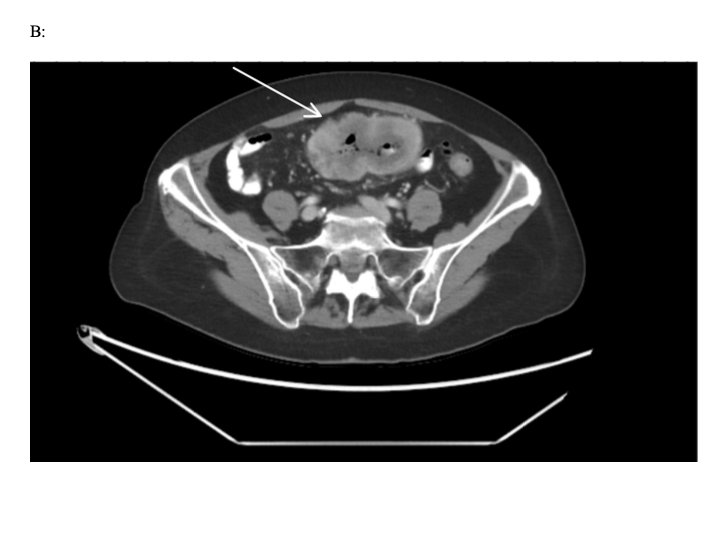
Following the osteopathic tenet that persistent structural asymmetry may signal deeper physiologic imbalance, the physician recommended diagnostic imaging. The patient was referred for CT scanning of the abdomen and pelvis, which subsequently revealed a 5.9-cm ulcerated mass in the mid-transverse colon, with a small enterocolic fistula. These findings were consistent with adenocarcinoma (Figures 1A,B).
Figures 1A,B: CT with contrast showing a 5.9cm transverse colon mass and fistula into the adjacent small bowel [A: coronal view, B: transverse view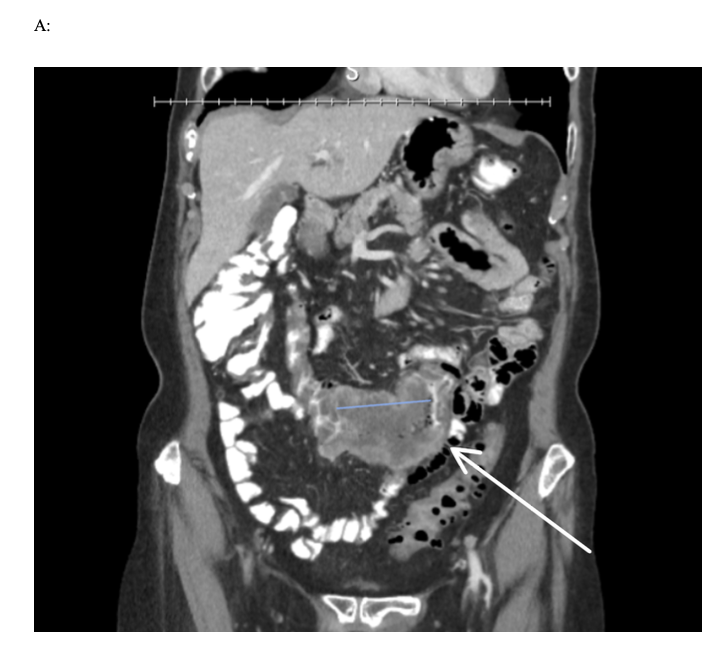
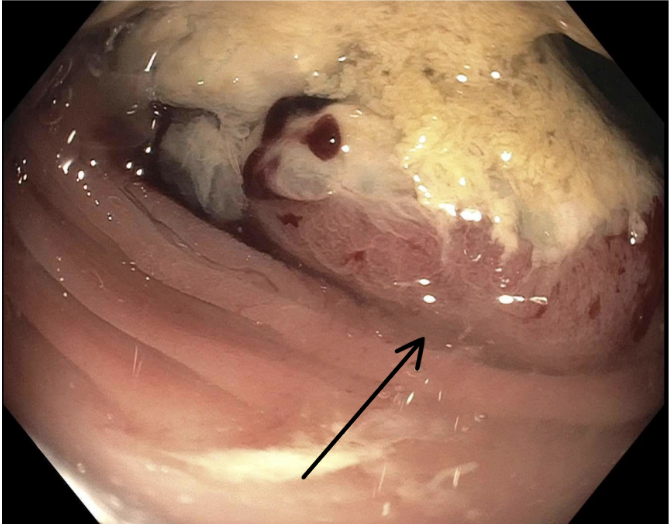
Colonoscopy and biopsy confirmed a moderately differentiated adenocarcinoma, microsatellite instability-high (MSI-H), harboring an FBXW7 mutation, which is a marker associated with favorable prognosis when identified early (Figure 2). The diagnosis was made before the patient exhibited any classical alarm features of colorectal malignancy.
Figure 2: Colonoscopy image demonstrating a sessile, malignant, ulcerated, partially obstructing mass with oozing in the mid-transverse colon
Findings and Clinical Course
The patient underwent segmental colectomy with primary anastomosis. Postoperative recovery incorporated osteopathic manipulative treatment (OMT) as an adjunctive measure to optimize respiratory mechanics and lymphatic flow. Techniques included the following:
- Thoracic inlet release to improve venous and lymphatic drainage.
- Suboccipital decompression to balance autonomic tone.
- Cranial osteopathic technique (frontal and parietal lift, gentle CV4) to promote cerebrospinal fluid fluctuation and parasympathetic normalization, supporting systemic recovery.
- Diaphragmatic doming and lymphatic pump to support pulmonary and abdominal motion.
The patient reported enhanced comfort and improved breathing within 48 hours of OMT initiation. Early mobilization was achieved without complications, and follow-up imaging at six months demonstrated no recurrence or metastasis.
Although the osteopathic intervention itself did not treat the malignancy, it improved postoperative recovery and reinforced the central insight of the case: namely, that palpation, when used for purposes of preventive awareness, can prompt lifesaving diagnostic action. Notably, while this report highlights the diagnostic potential of palpation, further controlled studies are needed to determine the sensitivity and specificity of such findings for early visceral disease.
Analysis: The Neurophysiology of Palpation
It helps to consider the underlying biology to understand how a physician's fingertips can detect disease before symptoms arise: the glabrous skin of each fingertip pad (approximately 1 cm²) contains 200-250 mechanoreceptive afferent units per cm², amounting to roughly 1,000 tactile nerve fibers per fingertip. Across both hands, this represents 8,000-10,000 sensory channels dedicated purely to touch. These afferents, including Meissner's and Merkel's cells, Ruffini endings, and Pacinian corpuscles, encode pressure, texture, and motion at the micrometer level.
Osteopathic physicians develop their palpatory skills to serve as a disciplined application of this sensory system. Through repetition and reflection, osteopathic medical students learn to integrate these neural signals with anatomical and physiologic reasoning. What might begin as subjective “feel” evolves into measurable diagnostic awareness. Palpation thus becomes a form of applied neuroscience, linking sensory input to clinical decision-making.
In this case, the tactile anomaly represented the earliest manifestation of altered viscerosomatic tension. The colon, tethered by mesenteric fascia and enveloped in peritoneum, shares neural and fascial continuity with the thoracolumbar region. Subtle alterations in motility, fluid dynamics, or connective tissue compliance may precede detectable mass formation. The osteopathic hand, guided by experience and cortical matter devoted to tactile perception, can sense such irregularities before they translate into pain or organ dysfunction.
Discussion: Implications for Preventive Medicine
This case illustrates the unique contribution that osteopathic physicians can make to advance preventive medicine. While screening programs remain essential, prevention is not limited to population-based strategies alone. It also occurs during those essential moments of patient contact when observation, empathy, and touch intersect.
In primary care, physicians routinely encounter patients with vague, nonspecific complaints that do not meet criteria for immediate imaging. The osteopathic approach encourages the clinician to integrate structural findings into their decision process. Subtle yet persistent asymmetries, especially when localized, unresponsive to manipulation, or inconsistent with benign musculoskeletal patterns, should prompt careful reassessment.
This model of care is low-cost, noninvasive, and inherently preventive. It relies not on modern technology, but on refined human perception. Furthermore, it can be especially valuable in populations with barriers to screening, where trust in a physician's attentiveness may also encourage further testing or compliance with recommendations.
This case also demonstrates how preventive medicine can extend into post-treatment recovery. OMT can enhance lymphatic circulation, reduce postoperative pain, and improve patient satisfaction. In this case, it likely contributed to the patient's smooth postoperative course and early ambulation.
Beyond physiology, sophisticated and compassionate touch can restore connection. Patients recovering from surgery often describe feeling isolated or mechanized within hospital routines. The reintroduction of therapeutic contact during recovery reinforces a sense of agency and healing, thereby serving as a preventive measure against the emotional sequelae of illness. For osteopathic family physicians, integrating structural assessment into annual wellness visits or Medicare preventive exams may offer a practical pathway to implement these principles.
Recommendations
To strengthen osteopathic palpation's role in preventive medicine, three domains warrant attention:
- Clinical Integration: Family physicians should document their palpatory findings in a structured manner, noting areas of persistent asymmetry, temperature change, or compliance loss. These observations can supplement conventional diagnostic reasoning and justify further testing when appropriate.
- Education and Research: Osteopathic medical schools should emphasize palpation as both a sensory and an analytical discipline. Objective measures such as motion-tracking sensors or ultrasound correlates can enhance inter-examiner reliability and academic acceptance. Research exploring palpatory findings correlated with imaging outcomes could be utilized to help validate its preventive capacity.
- Public Health Context: Osteopathic palpation and structural exams may serve as an early warning system, especially in communities with limited access to screening. By teaching tactile literacy to community clinicians, health systems can extend early detection capability without necessitating additional cost infrastructure.
Conclusion: Prevention as Presence
Preventive medicine is most effective when grounded in presence and attention. This case demonstrates that osteopathic palpation (when practiced with precision, patience, and curiosity) can reveal disease before it announces itself. The early recognition of an occult malignancy through tactile assessment reaffirmed the osteopathic principle that structure and function are inseparable, and that the body continually communicates its internal state to those trained to perceive it.
Incorporating palpation as a standard component of preventive visits could enhance early detection, reduce health care costs, and reaffirm the osteopathic commitment to treating the whole person. Touch is ancient, accessible, scientifically grounded, and remains one of medicine's most powerful diagnostic tools. As family physicians navigate an increasingly technological landscape, this case invites a return to the foundational skills that distinguish osteopathic medicine: the ability to listen, not only with the mind, but with the hands.
-----------
References
- Siegel RL, Miller KD, Wagle NS, Jemal A. Cancer statistics, 2023. CA Cancer J Clin. 2023;73(1):17–48.
- Macrae F, Muto T. Clinical presentation, diagnosis, and staging of colorectal cancer. In: Post TW, ed. UpToDate. Waltham, MA: UpToDate Inc; 2025. Accessed October 2025.
- National Cancer Institute. Colon cancer treatment (PDQ®): Health professional version. Updated 2025. Accessed October 2025. https://www.cancer.gov/types/colorectal/hp/colon-treatment-pdq
- Terzić J, Grivennikov S, Karin E, Karin M. Inflammation and colon cancer. Gastroenterology. 2010;138(6):2101–2114.e5.
- Chalabi M, Verschoor YL, Tan PB, et al. Neoadjuvant immunotherapy in locally advanced mismatch repair–deficient colon cancer. N Engl J Med. 2024;390(21):1949–1958.
- Le DT, Uram JN, Wang H, et al. PD-1 blockade in tumors with mismatch-repair deficiency. N Engl J Med. 2015;372(26):2509–2520.
- André T, Shiu KK, Kim TW, et al. Pembrolizumab in microsatellite-instability–high advanced colorectal cancer. N Engl J Med. 2020;383(23):2207–2218.
- Korphaisarn K, Morris VK, Overman MJ, et al. FBXW7 missense mutation: a novel negative prognostic factor in metastatic colorectal adenocarcinoma. Oncotarget. 2017;8(24):39268–39279.
- Fan J, Deng J, Li J, et al. Clinical significance of FBXW7 loss of function in human cancers. Mol Cancer. 2022;21:87.
- Furness JB. The enteric nervous system and neurogastroenterology. Nat Rev Gastroenterol Hepatol. 2012;9(5):286–294.
- Spencer NJ, Hu H. Enteric nervous system: sensory transduction, neural circuits and gastrointestinal motility. Nat Rev Gastroenterol Hepatol. 2020;17(6):338–351.
- Johansson RS, Vallbo AB. Tactile sensory coding in the glabrous skin of the human hand. J Physiol. 1979;286:283–300.
- Patterson MM. Palpation: what is its role in osteopathic medicine? J Am Osteopath Assoc. 2000;100(6):380–386.
- Aubin A, Gagnon K, Morin C. The seven-step palpation method: a proposal to improve palpation skills. Int J Osteopath Med. 2014;17(1):66–72.
- Snider EJ, Pamperin K, Johnson JC, Shurtz NR, Degenhardt BF. Assessing palpation thresholds of osteopathic medical students using static lumbar models. J Am Osteopath Assoc. 2014;114(6):460–469.
- Chappell C, Dogbey G, Dankart K. Evaluating the perception of motion in osteopathic medical students, residents, and physicians. AAO J. 2011;21(1):38–42.
- Kuchera ML, Kuchera WA. Osteopathic Considerations in Systemic Dysfunction. 2nd ed. Dayton, OH: Greyden Press; 1994.
- Chila AG, ed. Foundations of Osteopathic Medicine. 3rd ed. Philadelphia, PA: Lippincott Williams & Wilkins; 2010.
- Hodge LM, King HH, Williams AG Jr, et al. Abdominal lymphatic pump treatment increases leukocyte count and flux in thoracic duct lymph. Lymphat Res Biol. 2007;5(2):127–133.
- Hodge LM, Bearden MK, Schander A, et al. Lymphatic pump treatment mobilizes leukocytes from gut-associated lymphoid tissue into lymph. Lymphat Res Biol. 2010;8(2):103–110.
- Randall CG, Paul HA, Lumley H, et al. Osteopathic manipulative treatment during postoperative recovery: a scoping review. Cureus. 2024;16(2):e54233.
- Boulet JR, Sandella JM, Gimpel J, LaBaere RJ. Assessing fundamental clinical skills of osteopathic medical students. J Osteopath Med. 2025;125(10):469–476.
- Licciardone JC, Brimhall AK, King LN. Osteopathic manipulative treatment for low back pain: a systematic review and meta-analysis of randomized controlled trials. BMC Musculoskelet Disord. 2005;6:43.