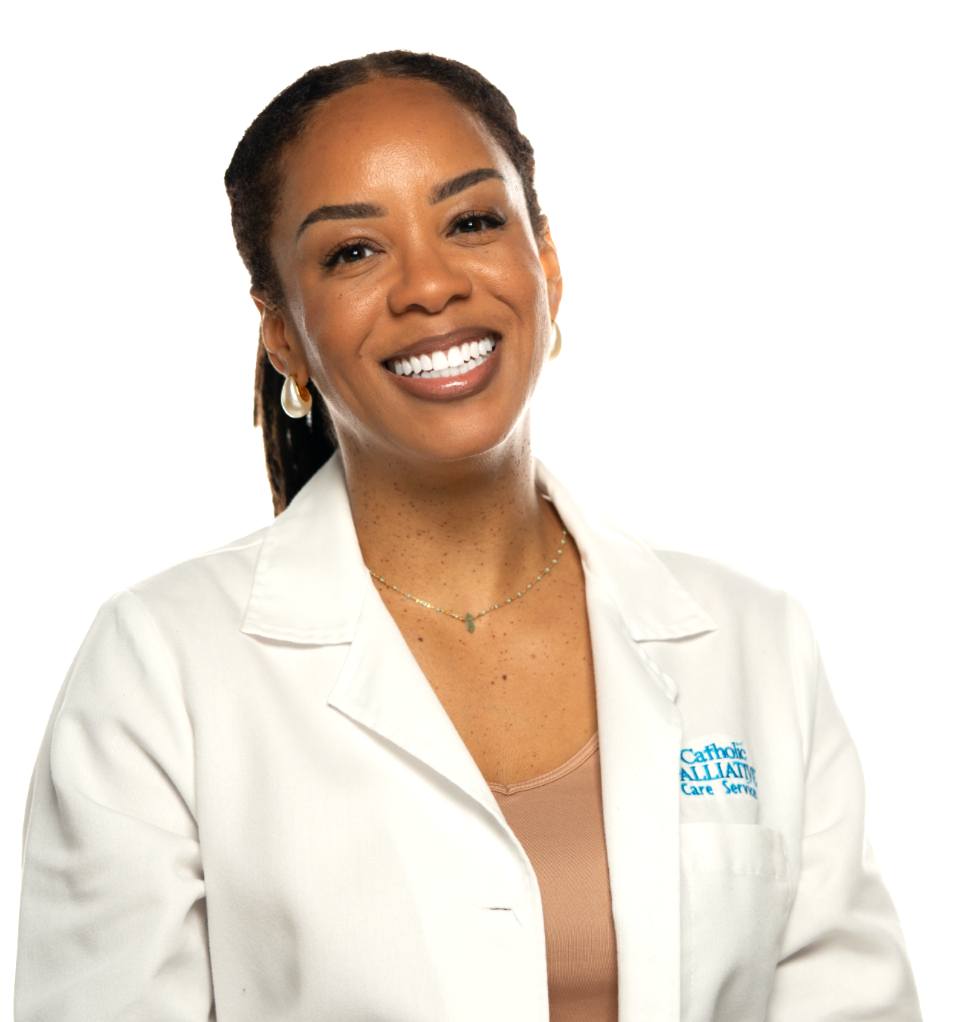
This first installment in a six-part series by hospice and palliative care physician Dr. Tracy Romanello, DO, FACOFP, FAAHPM, HMDC, explores the art and responsibility of caring for patients facing serious illness through the lens of osteopathic family medicine.
There is a particular silence that settles into a room when a patient asks, “Doctor…am I dying?”
Osteopathic family physicians know this moment well, and it can feel especially daunting because we connect with our patients far beyond their diagnosis. We know their families, fears, personalities, and the subtle changes that often emerge before a disease state appears on imaging findings or in specialist notes. Yet conversations surrounding serious illness, poor prognosis, and mortality can still feel difficult to navigate, and are sometimes deferred to consultants, hospital teams, or simply to “later,” for many understandable reasons. We worry about taking away hope. We worry about being wrong. We worry about opening a door we may not have enough time to walk through.
But over many years, both from the lens of a family physician and a medical director specializing in palliative and hospice medicine, I have come to believe that avoiding these conversations rarely protects patients and families. More often, it leaves them carrying fears and questions by themselves during some of the most vulnerable moments of illness.
One patient with terminal cancer said something to me that I have never forgotten: "Why does everyone keep talking like I'm going to beat this? Sometimes it feels like they need me to believe that more than I actually do." I found myself reflecting on that statement long after our visit. Patients often understand far more about their condition than we give them credit for. They may not know exact timelines, but they know when their body is changing. They know when treatments are no longer helping the way they once did. They know when their energy is fading, when walking is harder, when breathing feels different, and when life is becoming smaller. After all, nobody lives inside that experience more intimately than the patient.
As osteopathic physicians, we are uniquely prepared for these difficult conversations because our training has always extended beyond disease. We are taught to care for the whole person: body, mind, spirit, family, function, and meaning. The truth is that family physicians practice palliative care every day. We manage symptoms. We support caregivers. We help patients navigate uncertainty. We discuss goals, values, and trade-offs. We walk alongside people through chronic illness, not for days or weeks, but often for years.
Yet today’s medicine, amid rapidly evolving technological advances and treatment options, can unintentionally make serious illness conversations feel like admissions of defeat. If curative options are limited, we feel there is “nothing left to offer.” In reality, some of the most meaningful, impactful care we provide often begins in those very moments.
Honest conversations do not destroy hope. They reshape it. At first, hope may look like cure. Later, it may become hope for more time, better symptom control, attending a wedding, meeting a grandchild, remaining at home, or simply having a good day. Hope evolves, and family physicians are uniquely positioned to help patients navigate that transition.
Contrary to what many clinicians fear, patients do not require perfect words or polished answers. More often, they need presence, honesty, and someone willing to stay in the conversation. Sometimes the most meaningful questions are remarkably simple: “What are you hoping for?” “What worries you most?” “What feels most important to you right now?” These are not merely clinical questions; they are deeply human ones.
Amid the humanity of serious illness care, we should not forget that there can also be great moments of humor, and even laughter. A frail, elderly female with severe heart failure and witty one liners joked, “Doc, my heart is retiring before the rest of me got the memo…the other parts will eventually catch up.” We both laughed. In the soft spaces we create, laughter and grief can coexist. That’s not inappropriate; it is medicine at its most human. Some of the most meaningful encounters I have witnessed contained tears, jokes, silence, and profound honesty all within the same conversation.
When terminal illness conversations are delayed, patients often receive burdensome interventions inconsistent with their goals, families make crisis decisions without preparation, and hospice referrals occur far too late. Earlier discussions improve quality of life, reduce anxiety, and help align care with what matters most to the patient.
Family physicians should not outsource all serious illness communication. We understand context, family systems, baseline function, and patient values in ways few others do. Perhaps that is why family medicine remains one of the most powerful specialties in all healthcare. Offer yourself grace in knowing that you are not required to have every answer, and patients facing serious illness are not searching for perfection. They are searching for us. Our role is to show up, with honesty, presence, compassion, and guidance, and perhaps most importantly, with the willingness to stay in the room through the uncomfortable moments too. Sometimes the greatest gift we offer is not a perfect phrase or treatment plan, but simply being wholeheartedly present, even when the silence feels a little too long and the tissue box gets more use than the stethoscope.
Osteopathic family physicians were built for this work. It is time we reclaim it.
About Dr. Romanello
Dr. Tracy Romanello is a physician executive and recognized leader in hospice and palliative medicine, with more than a decade of experience advancing care across acute and post-acute settings in South Florida. She currently serves as a Medical Director for Catholic Hospice and Palliative Care Services and the Vice President of the Medical Staff at Catholic Health Services. Board-certified in Family Practice and Osteopathic Manipulative Treatment, and Hospice and Palliative Medicine, Dr. Romanello is a Fellow of the American College of Osteopathic Family Physicians and the American Academy of Hospice and Palliative Medicine. She is the founding visionary of an integrated palliative care program that includes inpatient consultation, community-based services, and a fully accredited fellowship. Dr. Romanello serves on the Boards of the Broward County Osteopathic Medical Association and the Florida Hospice and Palliative Care Association. A dedicated educator, speaker, and nonprofit leader, she is committed to mentorship, innovation, and compassionate, high-value care.
Continue the conversation by contacting Dr. Romanello.