Congratulations to Sarin Sajan Itty, DO, PGY-3, first place winner of the 2026 Namey/Burnett Award. Sponsored by the ACOFP Foundation, with winners selected by the ACOFP Health & Wellness Committee, the Namey/Burnett Preventive Medicine Writing Award honors the memory of Joseph J. Namey, DO, FACOFP, and John H. Burnett, DO, FACOFP—dedicated advocates for osteopathic medicine—and recognizes the best preventive medicine blog posts submitted by osteopathic family medicine students and residents.
Introduction
In the United States, over a third of adults report sleeping less than 7 hours1; insomnia affects nearly 16.2% of people across the globe.2 As per an American Academy of Sleep Medicine (AASM) position published in the Journal of Clinical Sleep Medicine, sleep is a biological necessity.3 Ideal sleep architecture is composed of a cyclic process which alternates between three stages of non-rapid eye movement sleep and a fourth stage of rapid eye movement sleep.4 Adequate quality sleep allows for the body’s restorative processes to take place, which plays a critical role in improving cardiovascular status, mental health, immunity, cognition, memory formation, reproductive health and hormone regulation.4 Sleep is not only restorative but it is also protective ‒ protecting against multiple diseases by improving both physical and mental health.
Many core osteopathic principles address sleep as a form of preventative medicine. Optimizing sleep promotes the body’s self-healing mechanisms. Osteopathic manipulative treatment (OMT) techniques can be used as adjunct to behavioral and medical interventions to restore physiologic balance prior to the development of pathology. Osteopathic physicians view the body as an integrated unit of body, mind, and spirit. Sleep disorders often arise at the intersections of these domains, influenced by stress, mental health challenges, musculoskeletal dysfunctions. By optimizing autonomic regulation and addressing structural imbalances of the body by utilizing OMT, osteopathic physicians can help facilitate a more restful sleep.
Family medicine physicians are at the forefront of being able to identify and manage sleep disorders; they can have a substantial impact on chronic disease by emphasizing preventive care and education. Despite the high prevalence of sleep disorders within primary care and the growing emphasis on nonpharmacological interventions, there is a limited discussion within the literature regarding the role of OMT in the treatment of sleep disorders. Our research intent is to assess the impact of inadequate sleep on health, address the current state of screening for sleep disorders, and to evaluate the use of osteopathic interventions in the management of sleep disorders.
Methods
For this narrative review, a mixture of qualitative and quantitative peer-reviewed research articles were selected that addressed the subjects of preventative medicine and chronic disease in sleep disorders. Other included articles discussed the role and efficacy of OMT in treating sleep disorders. Several databases were reviewed including PubMed and Google Scholar using various keywords including "sleep," "osteopathic," “public health,” "osteopathic manipulative therapy" and "preventative medicine." Articles published prior to 2016 were excluded. Additional exclusion criteria included articles which discussed only non-osteopathic manual therapies.
Results
The Impact of Sleep on Health
Sleep is not just a biological process ‒ it is a key determinant in overall health and disease prevention. Poor sleep quality is associated with an increased risk for obesity, type 2 diabetes, high blood pressure, coronary heart disease, stroke, mental illness, neurodegenerative disease and all-cause mortality.1,5,6
Chronic sleep deprivation has significant impacts upon the physiological state, resulting in elevated cortisol and decreased testosterone levels, which contributes to the development of psychiatric disorders such as depression and anxiety.7 These physiological states can impact the development of obesity and comorbid medical conditions and also leads to an overall reduced quality of life.5 A review article published by Chasens et al. demonstrated evidence that there is an association between metabolic syndrome and short sleep duration, circadian disturbance, insomnia and sleep apnea; it proposed a mechanism in which impaired sleep worsens metabolic control.8
In the elderly, the prevalence of sleep disorders is even higher with increased sleep interruptions, considering they spend a longer time in lighter sleep than deeper sleep and have a less efficient circadian rhythm; obstructive sleep apnea, periodic limb movement disorder, and restless leg syndrome are also more common in the elderly.9 In particular, obstructive sleep apnea puts individuals at an increased risk for cardiovascular disease, headaches, memory loss, and depression.9
Poor sleep has also been implicated as risk factors in the development of neurodegenerative disease such as Parkinson's Disease and Alzheimer's disease.5 A systematic review and meta-analysis by Meng et al. revealed that insomnia may significantly contribute to the risk of all-cause dementia, which is why early intervention and management is important.10
Screening for Sleep Disorders
As per the AASM, clinicians should inquire about sleep habits and symptoms during patient encounters.3 In an article published in Preventive Medicine Reports, Chaput & Shiau include six simple questions which can be used to assess sleep health in clinic when obtaining a patient's health history11 (Figure 1, questions included with permission from Chaput). They advocate for clinicians to assess key sleep characteristics including sleep duration, sleep quality, sleep timing, daytime alertness, and the absence of a sleep disorder.11
In a retrospective chart review published within the Journal of Clinical Sleep Medicine, progress notes from initial clinical encounters for insomnia were analyzed.12 The majority of progress notes did not have any information related to insomnia risk factors and symptoms; nearly 52% of patients were prescribed sleep medications while only 5% of patients with insomnia were referred for cognitive behavioral therapy.12 This approach is not optimal considering that patient education is an essential component of preventative treatment in improving sleep, which involves extensive sleep hygiene education and assessment of the patient's current sleep habits.7
Figure 1: 6 Simple Questions that Can Be Included in the Assessment of Sleep Health
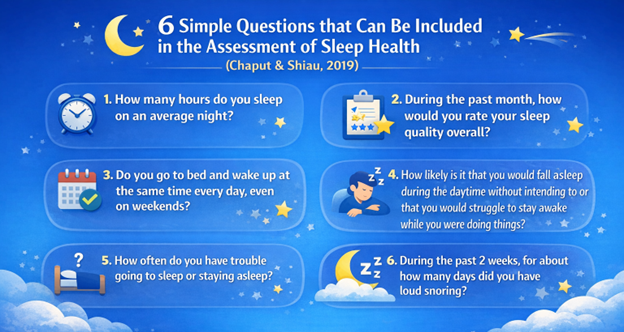
AI-based tool was used for illustrative figure creation only; written permission was obtained from study authors to include their questions.
Osteopathic Interventions in The Management of Sleep Disorders
Along with nutrition and physical activity, adequate and high quality sleep is a foundational pillar of preventative medicine. The optimal approach for long-term sleep hygiene is through behavior and sleep habit modification, with recommendations including obtaining 7-9 hours of sleep, having a consistent sleep wake schedule, following a bedtime routine, and regular exercising4. Avoiding caffeine, alcohol, heavy meals and light exposure later in the day can also help with improving sleep.4
There is limited literature regarding OMT use in treating sleep disorders. In a study published within the Journal of the American Osteopathic Association, OMT was investigated in a small randomized control trial featuring 30 student athletes who had a recent concussion.13 There was a beneficial relationship trend between OMT and sleep quality; however, due to the study’s small size and lack of a sham control group, the results were not statistically significant.13 Larger studies are needed to further investigate this relationship.
Other studies investigate sleep as a secondary outcome in the trial. In another randomized control trial, the impact of OMT in adults with low back pain was evaluated; participants had a significant reduction in self reported sleep disturbances and anxiety after one session of OMT.14 Further research is needed within the realm of osteopathic medical therapy for sleep disorders.
Discussion
This review emphasizes the need for increased screening for sleep disorders within the primary care setting. Sleep is an essential cornerstone of preventive health and prevalent sleep disorders represent a public health concern. Family medicine physicians play a critical role in identifying those at risk and educating patients regarding the long-term implications of sleep disorders in the development of chronic disease. Untreated sleep disorders carry a significant disease burden and can worsen medical and psychiatric illnesses. In addition to traditional treatments, OMT can be considered as an option for adjunctive treatment. An interprofessional approach including psychiatry professionals and sleep specialists may also be beneficial for the treatment of sleep disorders.7
In terms of public health advocacy, there needs to be stronger initiatives on improving sleep in promoting preventive health. Awareness needs to be spread to patients, clinicians, educators, and health advocates. Limitations of this narrative review include that it is prone to selection bias and features heterogeneous data. Further areas of research to consider include promoting public health awareness regarding the importance of sleep and also advocating for further standardized research projects evaluating the impacts of OMT in sleep disorders.
Conclusion
Inadequate sleep is prevalent and underdiagnosed, resulting in a myriad of detrimental consequences for human health. Considering the significant burden of sleep disorders, family medicine clinics should be screening more for sleep disorders when establishing a patient's health history. Family medicine physicians have a central role in educating and treating patients with sleep disorders, emphasizing that sleep has a vital role in preventive health. Osteopathic physicians should consider the use of OMT as an adjunct treatment for sleep disorders.
References
Liu Y, Wheaton AG, Chapman DP, Cunningham TJ, Lu H, Croft JB. Prevalence of healthy sleep duration among adults—United States, 2014. MMWR Morb Mortal Wkly Rep. 2016;65(6):137-141. doi:10.15585/mmwr.mm6506a1
Benjafield AV, Sert Kuniyoshi FH, Malhotra A, et al. Estimation of the global prevalence and burden of insomnia: a systematic literature review-based analysis. Sleep Med Rev. 2025;82:102121. Doi: 10.1016/j.smrv.2025.102121
Ramar K, Malhotra RK, Carden KA, Martin JL, Abbasi-Feinberg F, Aurora RN, et al. Sleep is essential to health: an American Academy of Sleep Medicine position statement. J Clin Sleep Med. 2021;17(10):2115-2119. doi:10.5664/jcsm.9476
Baranwal N, Yu PK, Siegel NS. Sleep physiology, pathophysiology, and sleep hygiene. Prog Cardiovasc Dis. 2023;77:59‑69. doi:10.1016/j.pcad.2023.02.005.
Hale L, Troxel W, Buysse DJ. Sleep health: an opportunity for public health to address health equity. Annu Rev Public Health. 2020;41:81-99. doi:10.1146/annurev-publhealth-040119-094412
Li C, Shang S. Relationship between sleep and hypertension: findings from the NHANES (2007–2014). Int J Environ Res Public Health. 2021;18(15):7867. doi:10.3390/ijerph18157867
Hanson JA, Huecker MR. Sleep deprivation. In: StatPearls [Internet]. Treasure Island, FL: StatPearls Publishing; 2025. Available from: https://www.ncbi.nlm.nih.gov/books/NBK547676/
Chasens ER, Imes CC, Kariuki JK, et al. Sleep and metabolic syndrome. Nurs Clin North Am. 2021;56(2):203-217. doi:10.1016/j.cnur.2020.10.012
Gulia KK, Kumar V. Sleep disorders in the elderly: a growing challenge. Psychogeriatrics. 2018;18(3):155-165. doi:10.1111/psyg.12319
Meng M, Shen X, Xie Y, Lan R, Zhu S. Insomnia and risk of all-cause dementia: a systematic review and meta-analysis. PLoS One. 2025;20(4):e0318814. doi:10.1371/journal.pone.0318814
Chaput JP, Shiau J. Routinely assessing patients’ sleep health is time well spent. Prev Med Rep. 2019;14:100851. doi:10.1016/j.pmedr.2019.100851
Sun J, McPhillips MV, Chen KC, et al. Primary care provider evaluation and management of insomnia. J Clin Sleep Med. 2021;17(5):1083-1091. doi:10.5664/jcsm.9154
Mazzeo S, Silverberg C, Oommen T, et al. Effects of osteopathic manipulative treatment on sleep quality in student athletes after concussion: a pilot study. J Am Osteopath Assoc. 2020. doi:10.7556/jaoa.2020.100
Popovich JM Jr, Cholewicki J, Reeves NP, et al. The effects of osteopathic manipulative treatment on pain and disability in patients with chronic low back pain: a single-blinded randomized controlled trial. J Osteopath Med. 2024;124(5):219-230. doi:10.1515/jom-2022-0124